Skip to content

Blog

Recipe:

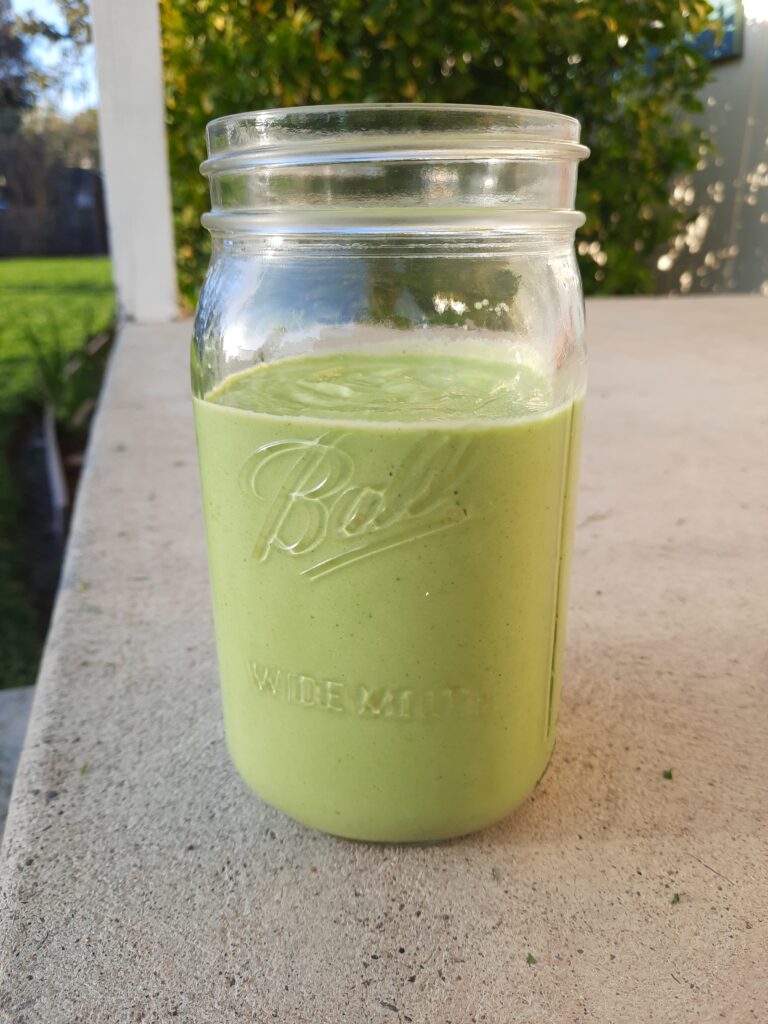
  • 1 medium tomato (roma or similar) (1.88 oz.,53 g)
  • 4 medium carrots (8.6 oz., 244 g)
  • 1/8 cup walnuts (0.5 oz., 14 g)
  • 1 tsp chia seeds (0.2 oz., 5 g)
  • Juice of one large lemon (1.5 fl oz., 42 ml)

Blend, pour over salad or dish of your choice. Enjoy!

If you enjoyed this presentation and if raw food nutrition explained to you in easy to understand terms in a fun format with plenty of time to sink in, a manageable time commitment, and plenty of opportunity to ask questions and get clarification directly from us is important to you, we invite you to join us for our online Mastering Raw Food Nutrition Course!

We are so happy to bring this program to you! We want you to experience all the joy and benefits eating and living this way has brought to our lives. We've listened and created this curriculum based on your input!

Mastering Raw Food Nutrition Program Details:

  • 12 Month Online and Interactive Course
    • Our next program will begin on August 27, 2025. 
    • You can schedule a time to speak with us about Mastering Raw Food Nutrition here:     
    •  https://masteringrawfoodnutrition.as.me/
  • Self-Paced Version Now Available!
    • You may now join the self-paced version of this course at any time. If you are considering joining the class you can schedule an information session with us at the bottom of this page. Please continue reading about the course below.
  • Time Commitment: about 4 hours per week
    • 2 hours of information-dense, easy-to-follow educational video content
    • Four comprehensive, professionally printed and bound, 8.5" x 11" sets of paperback notes including graphics that follow along with our presentations. Close to 900 pages of notes between all four notebooks.
  • 6 – 8 monthly live zoom meetings in real time with Drs. Rick or Karin Dina, D.C. in small group sessions.
    • You can access these via phone or through your computer. This is another 100+ hours of time over the course of the 12 months!
    • All meetings will be recorded in case you miss one and want to still listen in afterwards, or review later even if you were on the call.
    • You can even ask your questions in advance through the computer!
    • We have listened! Many people have told us they have trouble following through with other online courses and find regular opportunities to meet, ask questions, and have time for sharing experiences very valuable for understanding course information.
    • Other types of online courses do not offer the support provided in this class.
  • Our Mastering Raw Food Nutrition Course is a total of over 100 hours worth of solid instructional video content and 100+ additional hours of class discussion Q+A sessions that you can attend live or access once we've recorded them.
    • Please keep in mind that 100 hours from us is probably more like 500 or so hours elsewhere. For example, we purchased an online program a few years back that was 6 hours worth of content. We were very frustrated going through it because it easily could have been delivered in about an hour, without missing anything. We value your time as much as we value our own, and our commitment to you is make the best use of that time.
    • This curriculum is based on peer-reviewed research (thousands of journal articles), our personal experience of 35+ years each, our clinical experience, and our doctorate level educations, presented in an easy to understand format!

Interested in joining us for Mastering Raw Food Nutrition? Please click on this link to schedule a time to speak with us: https://masteringrawfoodnutrition.as.me/

Topics we cover in this class include and are not limited to the following:

  • Successful weight management
  • Blood sugar regulation from a dietary perspective
  • Acid/Alkaline balance
  • Food changes from cooking
    • Nutrient loss
    • Novel/toxic substance formation
  • Anti-inflammatory nutrition
  • Anti-aging and longevity
  • Minerals including iron, calcium, zinc, selenium, potassium, magnesium, iodine, etc...
  • Protein
  • Essential fatty acids
  • Antioxidants and phytonutrients
  • Choline, TMA, and TMAO
  • Understanding human digestion, absorption, and assimilation of nutrients
  • Soluble and insoluble fiber, resistant starch
  • The importance of water and high water content foods
  • Vitamins K1, K2, and D
  • Vitamins A, C, B1, B2, B3, B5, B6, B7, B9, B12, E, and more...
  • Beta-carotene, lycopene, lutein, zeaxanthin, and other carotenoids
  • Statistics in U.S. healthcare – We have the most costly healthcare system in the world, but are plagued by many diseases. Why? We will explore this question and more.
    • The quick fix approach vs. long-term change. How do health outcomes differ?
  • A history of the raw and living foods movement:
    • Natural Hygiene and the Ann Wigmore program contrasted with popular diet programs
  • Evolution within the raw food movement with growing national and international popularity
  • Personal responsibility and health achievement
  • Major studies in support of plant-based diets
  • Evaluation of the health promoting properties of different foods
  • Making sense of food labels
  • Phytoestrogens, soy, xenoestrogens
  • Enzyme theory and enzyme science
  • Food combining theory and practical applications
  • Essentials for success with raw foods
  • The history of human food choices
  • Grains - what they are and why they are so controversial
  • Organically grown produce - a scientific perspective
  • Nutrition from whole natural plant foods vs. supplements
  • More about essential fatty acids
  • Philosophy vs. science – the benefits and limitations of both
  • Comparison and contrast of different approaches to raw food nutrition
    • high fruit raw
    • low fruit raw
    • the importance of greens
    • much more
  • Comparison of raw food dietary approaches to other approaches
  • Avoidance of common pitfalls in raw food  and designing a health program for success
  • Raw food exaggerations and raw food facts
  • The effects of heating on food
  • The benefits of sprouting and greens, the science of sprouting
  • Antioxidants and phytonutrients
  • Nutrient synergy
  • Lighter eating for more energy
  • Healthy weight control
  • Raw superfoods, an objective and scientific look
  • Attitude and psychological considerations for healthy eating
  • Sleep and optimal health
  • Comparison of different types of fasts and cleanses
  • Food choices and ecological sustainability
  • Various supplements – what are they, what do they do, and do we actually need them?
  • Survey of sweeteners
    • What are the various sweeteners used by raw food enthusiasts and the population in general?
    • Are they good for us and what are healthy alternatives?
  • Advanced topics in weight loss and metabolism
    • Do hormones play a role?
    • How do diet, activity level, stress, sleep, etc. affect weight loss/gain?
  • Digestive health
    • The effect of various foods
    • Stress/emotional state
  • Probiotics, prebiotics, and microbiomes
  • Oxalate and oxalobacter formigenes
  • How our body utilizes carbohydrates, protein, and fat
  • Sea vegetables
  • Raw food challenges, pitfalls, and solutions
  • Different types of oils
    • What are they, are they really healthy and do we need them?
  • Nutrient analysis of popular raw food staples
  • What popular raw foods are nutrient powerhouses?
    • Is it necessary to spend a lot of money to be healthy?
  • The raw health continuum
    • Where do different foods fall on the scale of health?
  • The importance of fiber for intestinal health
  • Raw food / plant-based diet research
  • And so much more...

We invite you to learn more about this class can assist you in reaching your health and personal goals. To book a time to speak with us about registering for this curriculum, please click on this link:

https://masteringrawfoodnutrition.as.me/

2

Recipe:

  • 1.5 cups chopped zucchini (6.5 oz., 183 g)
  • 1/4 cup walnuts (1 oz., 28 g)
  • 1 tsp chia seeds ( 0.2 oz., 5 g)
  • Juice of one large lemon (1.5 fl oz., 42 ml)
  • 1 tsp chickpea miso (0.25 oz., 7 g) (optional)
  • One piece of yellow onion (size is your choice) one chopped green onion (optional)

Blend ingredients (we used a high-power blender). Pour over salad or dish of your choice! Enjoy!

If you enjoyed this presentation and if raw food nutrition explained to you in easy to understand terms in a fun format with plenty of time to sink in, a manageable time commitment, and plenty of opportunity to ask questions and get clarification directly from us is important to you, we invite you to join us for our online Mastering Raw Food Nutrition Course!

We are so happy to bring this program to you! We want you to experience all the joy and benefits eating and living this way has brought to our lives. We've listened and created this curriculum based on your input!

Mastering Raw Food Nutrition Program Details:

  • 12 Month Online and Interactive Course
    • Our next program will begin on August 27, 2025. 
    • You can schedule a time to speak with us about Mastering Raw Food Nutrition here:     
    •  https://masteringrawfoodnutrition.as.me/
  • Self-Paced Version Now Available!
    • You may now join the self-paced version of this course at any time. If you are considering joining the class you can schedule an information session with us at the bottom of this page. Please continue reading about the course below.
  • Time Commitment: about 4 hours per week
    • 2 hours of information-dense, easy-to-follow educational video content
    • Four comprehensive, professionally printed and bound, 8.5" x 11" sets of paperback notes including graphics that follow along with our presentations. Close to 900 pages of notes between all four notebooks.
  • 6 – 8 monthly live zoom meetings in real time with Drs. Rick or Karin Dina, D.C. in small group sessions.
    • You can access these via phone or through your computer. This is another 100+ hours of time over the course of the 12 months!
    • All meetings will be recorded in case you miss one and want to still listen in afterwards, or review later even if you were on the call.
    • You can even ask your questions in advance through the computer!
    • We have listened! Many people have told us they have trouble following through with other online courses and find regular opportunities to meet, ask questions, and have time for sharing experiences very valuable for understanding course information.
    • Other types of online courses do not offer the support provided in this class.
  • Our Mastering Raw Food Nutrition Course is a total of over 100 hours worth of solid instructional video content and 100+ additional hours of class discussion Q+A sessions that you can attend live or access once we've recorded them.
    • Please keep in mind that 100 hours from us is probably more like 500 or so hours elsewhere. For example, we purchased an online program a few years back that was 6 hours worth of content. We were very frustrated going through it because it easily could have been delivered in about an hour, without missing anything. We value your time as much as we value our own, and our commitment to you is make the best use of that time.
    • This curriculum is based on peer-reviewed research (thousands of journal articles), our personal experience of 35+ years each, our clinical experience, and our doctorate level educations, presented in an easy to understand format!

Interested in joining us for Mastering Raw Food Nutrition? Please click on this link to schedule a time to speak with us: https://masteringrawfoodnutrition.as.me/

Topics we cover in this class include and are not limited to the following:

  • Successful weight management
  • Blood sugar regulation from a dietary perspective
  • Acid/Alkaline balance
  • Food changes from cooking
    • Nutrient loss
    • Novel/toxic substance formation
  • Anti-inflammatory nutrition
  • Anti-aging and longevity
  • Minerals including iron, calcium, zinc, selenium, potassium, magnesium, iodine, etc...
  • Protein
  • Essential fatty acids
  • Antioxidants and phytonutrients
  • Choline, TMA, and TMAO
  • Understanding human digestion, absorption, and assimilation of nutrients
  • Soluble and insoluble fiber, resistant starch
  • The importance of water and high water content foods
  • Vitamins K1, K2, and D
  • Vitamins A, C, B1, B2, B3, B5, B6, B7, B9, B12, E, and more...
  • Beta-carotene, lycopene, lutein, zeaxanthin, and other carotenoids
  • Statistics in U.S. healthcare – We have the most costly healthcare system in the world, but are plagued by many diseases. Why? We will explore this question and more.
    • The quick fix approach vs. long-term change. How do health outcomes differ?
  • A history of the raw and living foods movement:
    • Natural Hygiene and the Ann Wigmore program contrasted with popular diet programs
  • Evolution within the raw food movement with growing national and international popularity
  • Personal responsibility and health achievement
  • Major studies in support of plant-based diets
  • Evaluation of the health promoting properties of different foods
  • Making sense of food labels
  • Phytoestrogens, soy, xenoestrogens
  • Enzyme theory and enzyme science
  • Food combining theory and practical applications
  • Essentials for success with raw foods
  • The history of human food choices
  • Grains - what they are and why they are so controversial
  • Organically grown produce - a scientific perspective
  • Nutrition from whole natural plant foods vs. supplements
  • More about essential fatty acids
  • Philosophy vs. science – the benefits and limitations of both
  • Comparison and contrast of different approaches to raw food nutrition
    • high fruit raw
    • low fruit raw
    • the importance of greens
    • much more
  • Comparison of raw food dietary approaches to other approaches
  • Avoidance of common pitfalls in raw food  and designing a health program for success
  • Raw food exaggerations and raw food facts
  • The effects of heating on food
  • The benefits of sprouting and greens, the science of sprouting
  • Antioxidants and phytonutrients
  • Nutrient synergy
  • Lighter eating for more energy
  • Healthy weight control
  • Raw superfoods, an objective and scientific look
  • Attitude and psychological considerations for healthy eating
  • Sleep and optimal health
  • Comparison of different types of fasts and cleanses
  • Food choices and ecological sustainability
  • Various supplements – what are they, what do they do, and do we actually need them?
  • Survey of sweeteners
    • What are the various sweeteners used by raw food enthusiasts and the population in general?
    • Are they good for us and what are healthy alternatives?
  • Advanced topics in weight loss and metabolism
    • Do hormones play a role?
    • How do diet, activity level, stress, sleep, etc. affect weight loss/gain?
  • Digestive health
    • The effect of various foods
    • Stress/emotional state
  • Probiotics, prebiotics, and microbiomes
  • Oxalate and oxalobacter formigenes
  • How our body utilizes carbohydrates, protein, and fat
  • Sea vegetables
  • Raw food challenges, pitfalls, and solutions
  • Different types of oils
    • What are they, are they really healthy and do we need them?
  • Nutrient analysis of popular raw food staples
  • What popular raw foods are nutrient powerhouses?
    • Is it necessary to spend a lot of money to be healthy?
  • The raw health continuum
    • Where do different foods fall on the scale of health?
  • The importance of fiber for intestinal health
  • Raw food / plant-based diet research
  • And so much more...

We invite you to learn more about this class can assist you in reaching your health and personal goals. To book a time to speak with us about registering for this curriculum, please click on this link:

https://masteringrawfoodnutrition.as.me/

Here’s a fun super-simple dessert (or anytime) recipe you can make in a pinch with common ingredients that you likely have in your house right now or can easily find at the grocery store: bananas, blueberries, dates, and walnuts.

Each of these parfaits pictured has 3 medium bananas, a small handful of blueberries, ½ ounce (or less) walnuts, and 1 date. For a smaller parfait, you can cut each of the ingredients in half.

To make this recipe, blend ½ of one banana with the walnuts and date. You can add a little water if the mixture is too thick. Set aside.

Then blend the remaining 2 ½ bananas, pour off half into a parfait glass of your choice. Pour or scoop the date-walnut-banana mixture unto the top of the blended banana in the parfait glass.

Blend the remaining banana mixture with the blueberries and then pour into the parfait glass on top of the date-walnut-banana mixture. Garnish with mint or leafy green/fruit of your choice.

The photo shows the banana-blueberry mixture on the bottom and the banana-only mixture on the top while the recipe above describes the opposite. From our experience, either has worked well and taste similar. Strawberries, raspberries, mulberries, blackberries are good in place of the blueberries too!

Enjoy!

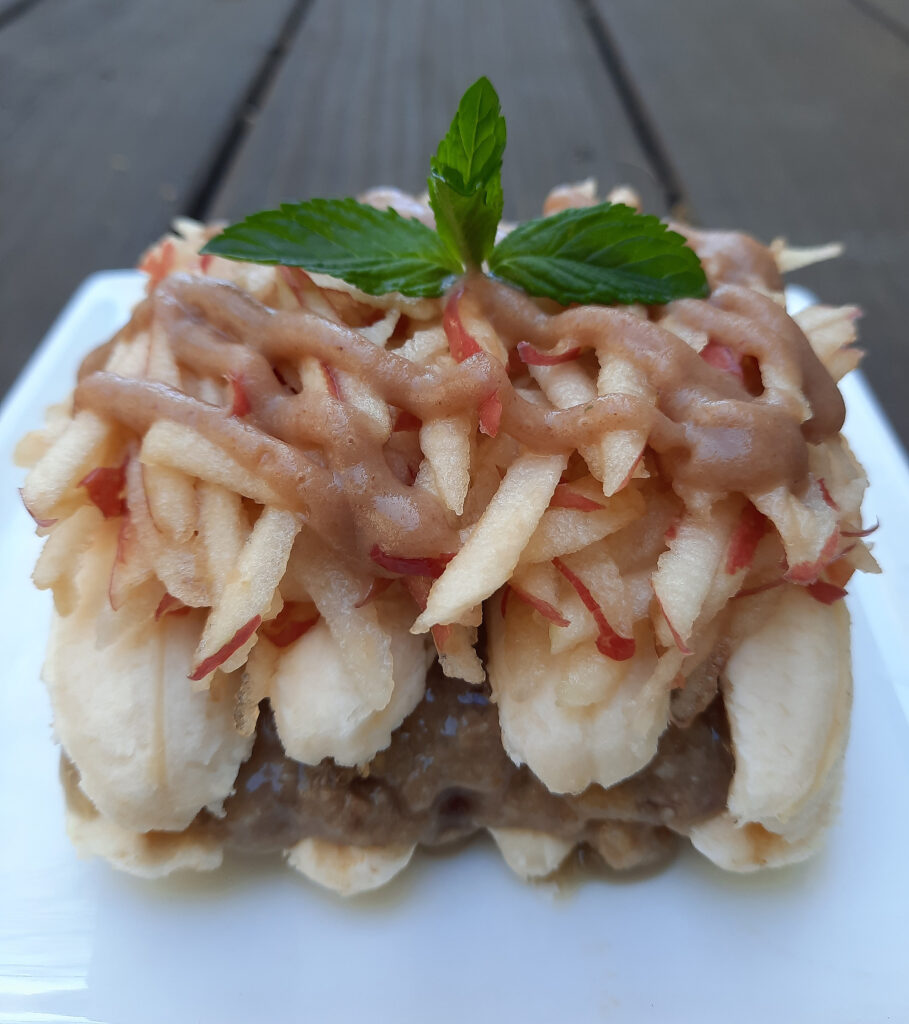
We’re on a raw pie kick this week! Here is the apple pie version of the recipe I shared earlier this week:

Ingredients:
2 medium bananas
½ medium fuji apple or apple variety of your choice
1 teaspoon fresh squeeze lemon juice
3 medjool or other type of dates
0.5 oz walnuts (1/8 cup, 13 g)

Peel bananas and cut each of them in half. Then pull them apart into their individual three sections – you should now have 12 banana sections (6 for each banana).

Line up 4 banana sections on a plate as shown in the photo. Next, blend 4 banana sections with the 2 dates and walnuts. Then, spread this mixture on top of the banana sections as shown.

Place the remaining 4 banana sections on top of the banana-date-walnut mixture.

Wash and shred ½ half of apple. Add lemon juice to apple shreds, mix and let stand for a few minutes. Place apple shreds on top of the pie as shown in photo.

Next blend remaining banana pieces with one date and a little water for consistency. Pour banana/date mixture over the tops of the pie. You can add a mint sprig to the if desired.

For a lower fat version, you can replace the walnuts with peeled zucchini or simply leave them out of the recipe.

Enjoy!

Additionally, would you like to receive our eBook "Our Top 12 Strategies for Long Term Success on A Raw Plant-Based Diet"? Just fill out the email form in the right column of this website and you’ll receive it for free!

2

Here is one of our favorite dessert recipes! It doesn’t require extensive preparation and we can make it in less than 15 minutes. This is the blueberry version of this recipe. Other versions are coming soon!

Ingredients:
2 medium bananas
Small handful of blueberries (strawberries or raspberries work well too)
2 medjool or other type of dates
0.5 oz walnuts (1/8 cup, 13 g)

Line up 4 banana sections on a plate as shown in the photo. Next, blend 4 banana sections with the 2 dates and walnuts. Then, spread this mixture on top of the banana sections as shown.

Place the remaining 4 banana sections on top of the banana-date-walnut mixture. Blend the small handful of blueberries alone or with an additional banana. Pour blueberry banana mixture over the top of the pie. You can add a mint sprig if desired.

For a lower fat version, you can leave out the walnuts.

Enjoy! Happy spring everyone!

Peel bananas and cut each of them in half. Then pull them apart into their individual three sections – you should now have 12 banana sections (6 for each banana).

Additionally, would you like to receive our eBook "Our Top 12 Strategies for Long Term Success on A Raw Plant-Based Diet"? Just fill out the email form in the right column of this website and you’ll receive it for free!

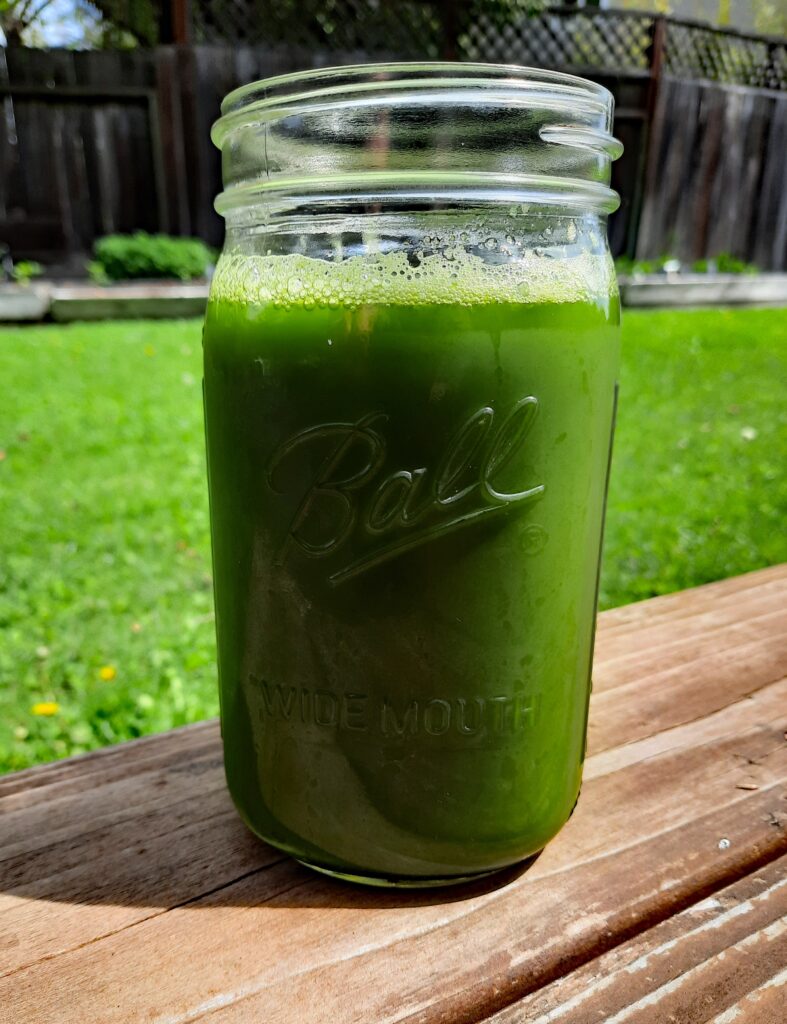
I’ve been juicing for the past few days and discovered my new favorite green juice. It’s actually super simple, with two ingredients – celery and dandelion greens. I used one head of celery and a handful of dandelion greens.

Here is a sampling of the nutrients found in these ingredients:

3 cups chopped dandelion greens (165 g) and 11 cups chopped celery (1100 g)

Vitamin B1 0.5 mg
Vitamin B2 1.1 mg
Vitamin B3 4.9 mg
Vitamin B5 2.9 mg
Vitamin B6 1.2 mg
Choline 126 mg
Folate 445 mg
Vitamin C 92 mg
Vitamin E 8.7 mg
Calcium 753 mg
Iron 7.3 mg
Magnesium 182 mg
Zinc 2.1 mg

It’s not surprising to see numbers like this when we put two nutrient powerhouses together!

Enjoy!

Additionally, would you like to receive our eBook "Our Top 12 Strategies for Long Term Success on A Raw Plant-Based Diet"? Just fill out the email form in the right column of this website and you’ll receive it for free!

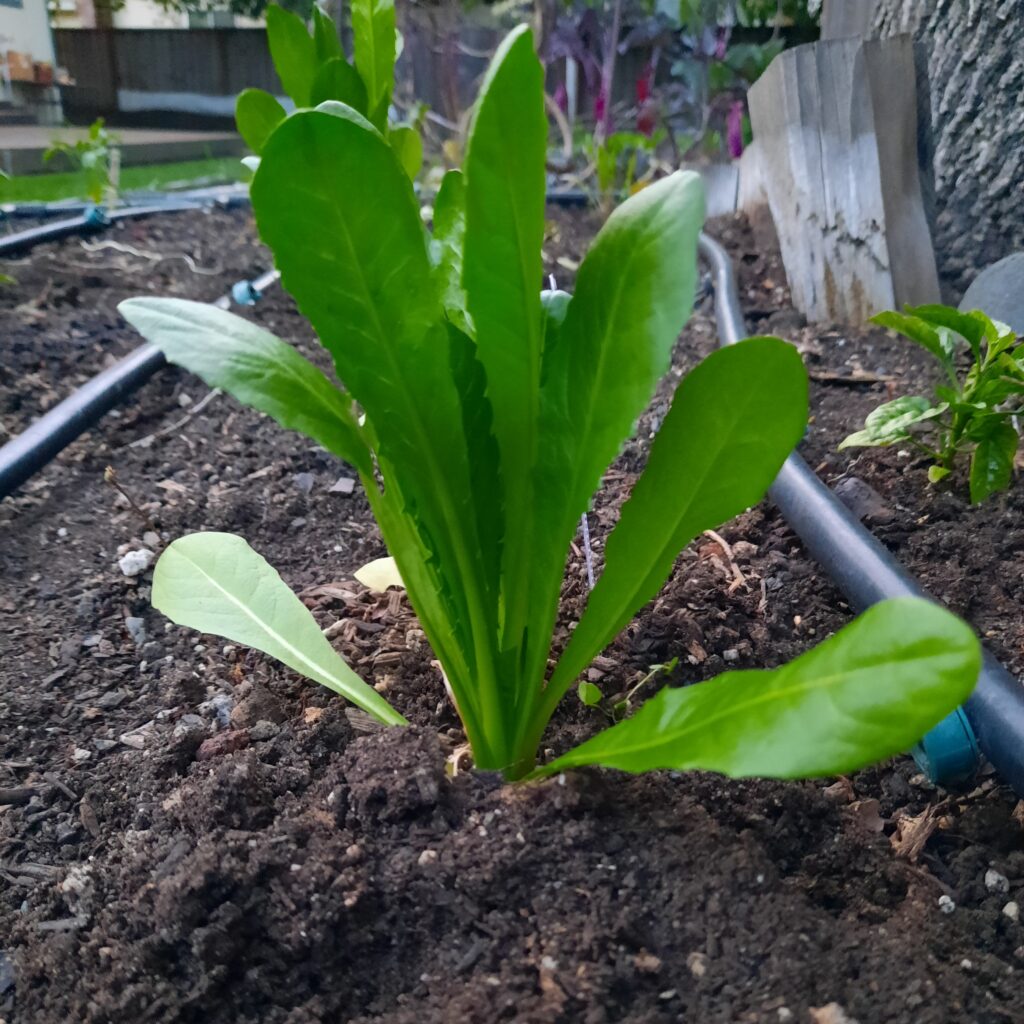
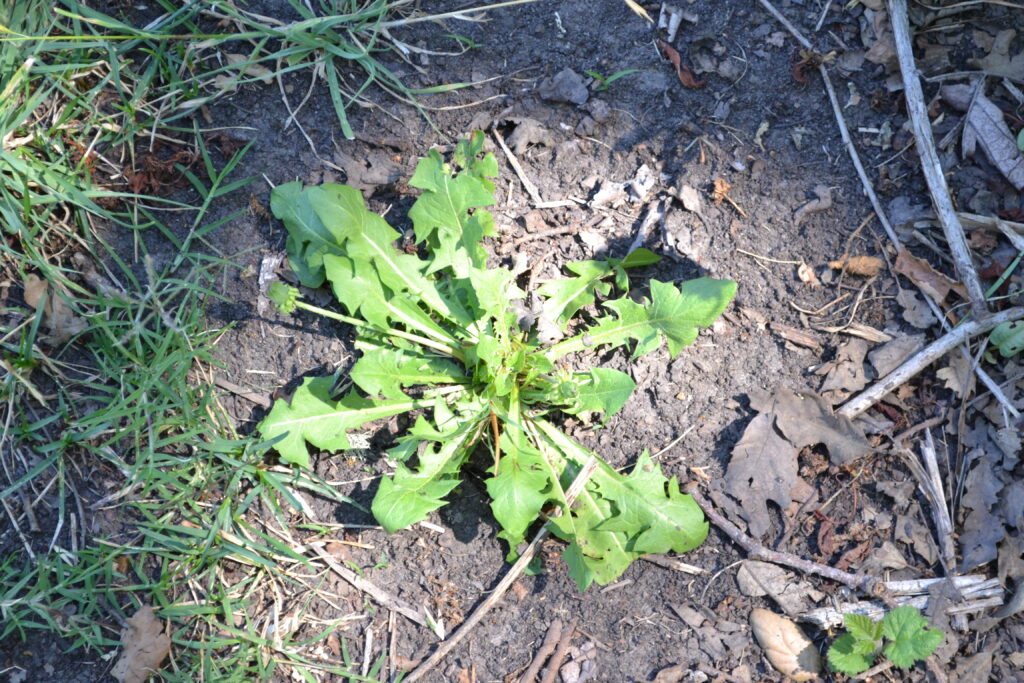
Yesterday, I was jumping for joy when I found dandelion green starts at a local nursery! You may be wondering why I would be happy to purchase plants that can be so easily found growing wild or in one’s backyard. The reason why is because these “dandelion” plants are a particular species commonly called Italian dandelion with the scientific name of Chicorium intybus. Italian dandelion is not a true dandelion as it has a blue flower and much longer leaves than your garden-variety dandelion, which has a yellow flower and generally shorter leaves. The scientific name for common dandelion is Taraxacum officinale.

So why am I making this distinction?

Because the dandelion greens you find in the grocery store are Italian dandelion greens. And the dandelion greens listed on most nutrient analysis software programs/apps are also Italian dandelion greens.

Here is the selected mineral content of Chicorium intybus according to Chronometer:

100 g chopped dandelion greens (almost 2 cups) Chicorium intybus
Calcium 206 mg
Iron 3.4 mg
Potassium 437 mg
Magnesium 40 mg

And I found a research study that measured the same minerals in Taraxacum officinale:

100 g dandelion greens Taraxacum officinale
Calcium 192 mg
Iron 3.1 mg
Potassium 393 mg
Magnesium 38 mg

As we can see here, the nutrient content per gram is similar between the two for the minerals tested. So, the bottom line is that even though most nutrient analysis software/apps do not contain common dandelion greens (Taraxacum officinale), one can use the nutrient data of Chicorium intybus in its place for the minerals shown here as a reasonable alternative.

One last note here: I just found a study with the nutrient content of Chicorium intybus that shows a calcium content of 293 mg per 100 grams and iron content of 9.2 mg per 100 grams which are both higher than the values we just discussed. This exemplifies that there can be nutrient differences between samples tested. I always look for multiple samples, compare the nutrient content between them, and look for trends in the data. More on this in a future post!

Additionally, would you like to receive our eBook "Our Top 12 Strategies for Long Term Success on A Raw Plant-Based Diet"? Just fill out the email form in the right column of this website and you’ll receive it for free!

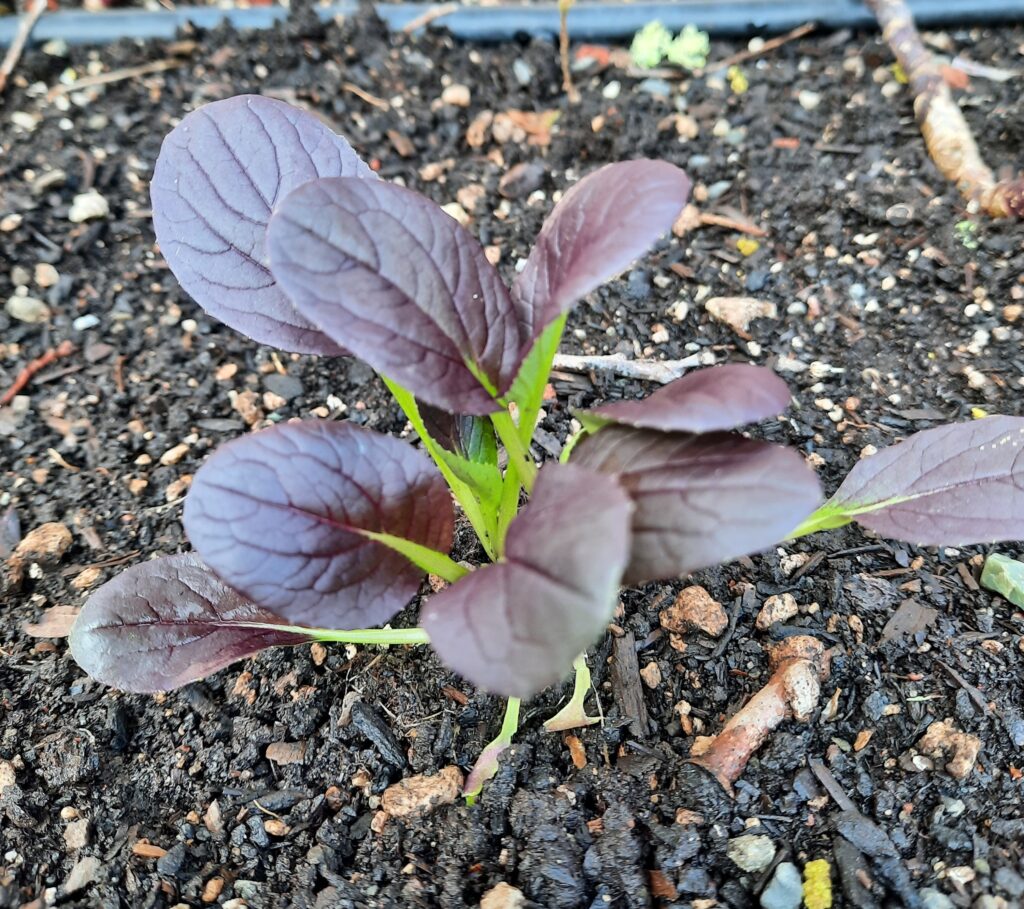
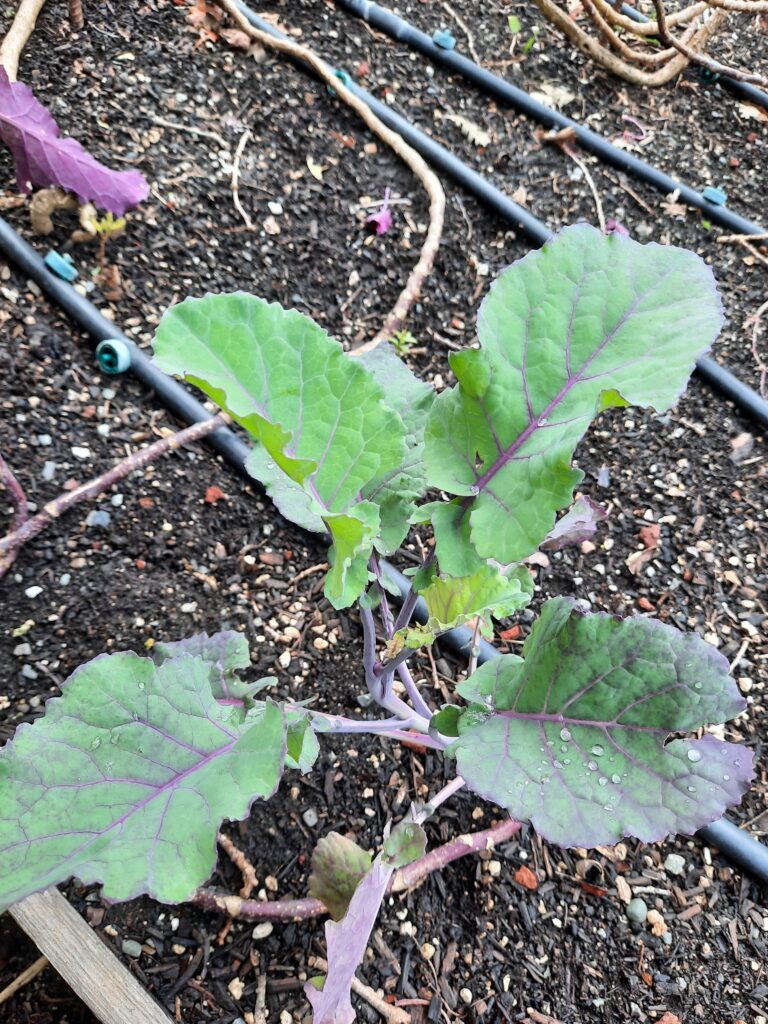
Spring green growing season has arrived – I was just thrilled to see bok choy starts at our local plant nursery last week! I have been a huge fan of bok choy for many years, especially after I saw the nutrient content of this lovely leafy green:

Bok choy – 3 cups chopped
Calcium 220.5
Iron 1.68
Zinc 0.40
Magnesium 39.9
Potassium 529.2
Folate 138.6
Vitamin C 94.5

Three cups of bok choy contains notable amounts of calcium, vitamin C, folate, and potassium. The calcium content of bok choy is exceptional among leafy greens and plant foods in general.

Bok choy, which also goes by the common name pac choi (there are actually a few common names), is a member of the cabbage plant family, also known as the Brassicaceae. Other members of this plant family include kale, cauliflower, and broccoli, which are also known for their notable calcium content. The cabbage family used to be known as the Cruciferae, which was originally named for the cross-like appearance of the flower petals among members of this plant family.

I love the purple color of this bok choy variety in addition to the usual dark green color of bok choy leaves. At this stage, bok choy leaves have a very mild flavor in comparison to mature bok choy plants.

Additionally, would you like to receive our eBook "Our Top 12 Strategies for Long Term Success on A Raw Plant-Based Diet"? Just fill out the email form in the right column of this website and you’ll receive it for free!

Early spring is here and we are enjoying early spring greens – especially our tree collard plants. We have several tree collard plants that have been in our garden for years, and they are still going strong and producing beautiful large green leaves.

What we love about our tree collards is that they are relatively low maintenance and are a reliable source of greens for us. Of course, we rotate our greens for variety so we are planting a variety of other greens in our garden this year, which we will cover in another post. These collard greens are tender and easily digestible for us in comparison to collard greens we find in the store that have a tougher consistency. We have observed over the years, that the greens that we grow in our garden tend to be softer and more tender than commercially available greens. Although this may not be true across the board, this is just an observation from our own personal experience.

Here is a sampling of the nutrients found in regular collard greens:

3 cups chopped collard greens (108 g)
Calcium 251 mg (This is great!)
Iron 0.5 mg
Folate 139 mcg
Beta-carotene 3230 mcg

How do these numbers compare to the nutrients found in actual tree collard greens? We have yet to know, given that I have not yet been able to find neutral information on the nutrients measured in actual tree collard leaves. I would not be surprised if they are similar. This is the beauty of science and research, there is much that is known and much that has yet to be known.

Happy spring!

Additionally, would you like to receive our eBook "Our Top 12 Strategies for Long Term Success on A Raw Plant-Based Diet"? Just fill out the email form in the right column of this website and you’ll receive it for free!

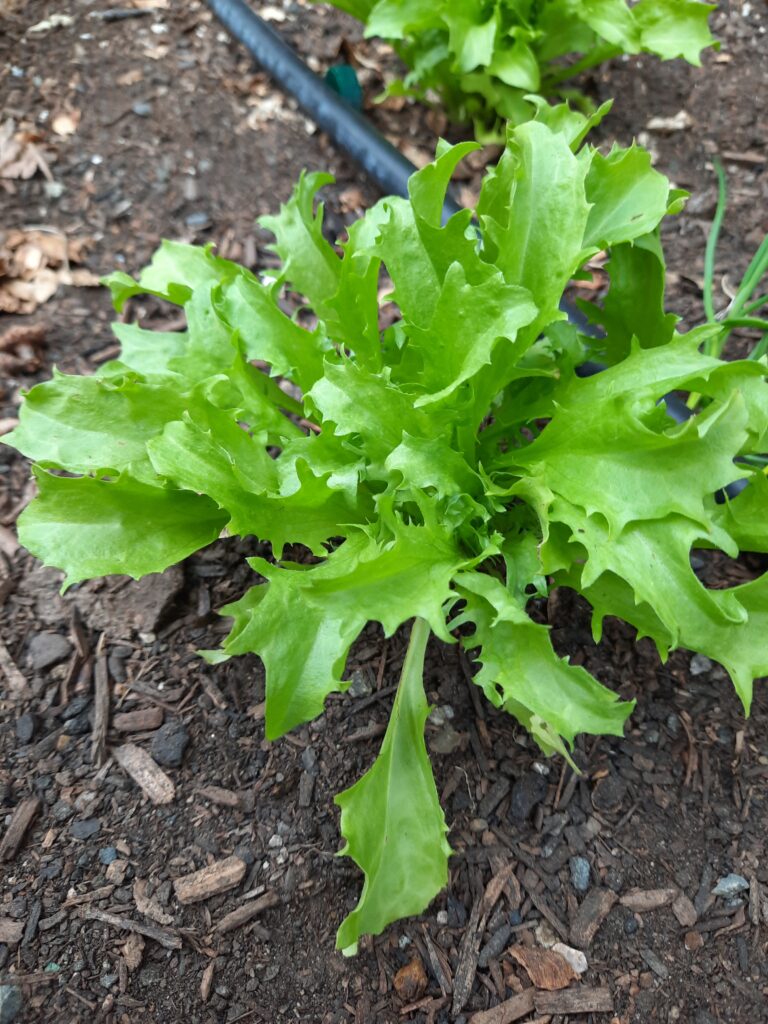
While shopping for plant starts last week, we found some starts for frisée greens. Have you ever heard of them or seen them?

The reason I ask is because they are one of the “unsung heroes” of the leafy greens. They can be challenging to find in grocery stores, but if you can find them, they are a worthwhile purchase. As the photos show, frisée greens have curly leaves with light to dark green coloring, with a yellowish tint toward the center of the plant, especially as the plant grows and matures. Frisée greens are in the sunflower plant family which also includes dandelion greens, escarole, endive, and the different varieties of lettuce.

Here is a nutrient comparison of frisée greens with Romaine lettuce:

3 cups chopped frisée greens (150 g)
Calories 25 kcal
Calcium 78 mg
Iron 1.2 mg
Zinc 1.2 mg
Potassium 471 mg
Magnesium 23 mg

3 cups chopped Romaine lettuce (141 g)
Calories 24 kcal
Calcium 46.5 mg
Iron 1.4 mg
Zinc 0.3 mg
Potassium 348 mg
Magnesium 20 mg

In general, Romaine lettuce is thought to be one of the highest in nutrient content in the sunflower family, however frisée greens are higher per calorie in the important minerals: calcium, zinc, potassium, and magnesium. It’s also higher in a number of other nutrients not listed here. As an aside note, frisée can have a bitter flavor (which I actually like), so adding it to salad with a milder lettuce can help balance the bitterness. From our experience, growing it at home can significantly reduce the bitterness 😊

Enjoy!

Additionally, would you like to receive our eBook "Our Top 12 Strategies for Long Term Success on A Raw Plant-Based Diet"? Just fill out the email form in the right column of this website and you’ll receive it for free!

2

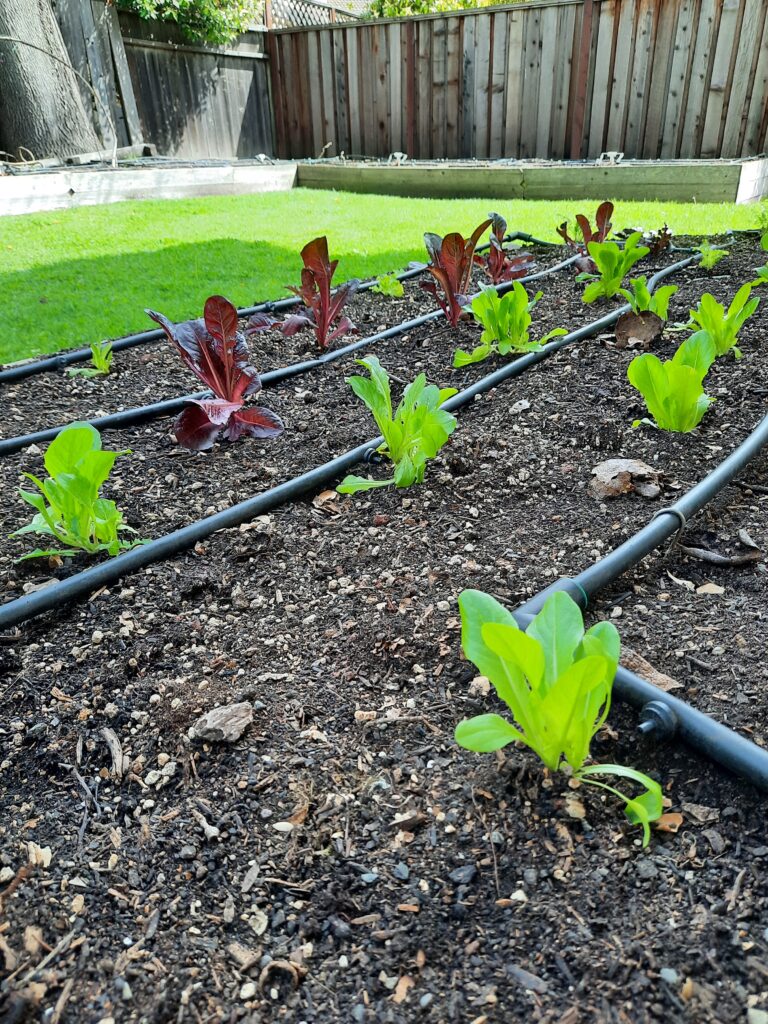
Getting started early with the garden this year! Liam was especially excited about planting the lettuce starts. He now checks on them every day to watch their progress! We're involving him in the care of plants from a young age, and already, he's enjoying gardening. He's also starting to enjoy eating various garden vegetables, and soon we'll be planting more of his favorites - we'll post photos as the season progresses.

In the meantime, here is one of my personal favorite garden vegetable salads:

10 cups torn romaine lettuce (470 g)
3 cups chopped dandelion greens (165 g)
1.5 cups grated cucumber (170 g)
1 cup grated carrots (110 g)
1 cup grated zucchini (149 g)
0.5 cup chopped tomato (90 g)

Nutrient analysis:
Vitamin B1 0.9 mg
Vitamin B2 1.0 mg
Vitamin B3 5.3 mg
Vitamin B5 1.9 mg
Vitamin B6 1.3 mg
Choline 145 mg
Folate 765 mcg
Vitamin C 127 mg
Vitamin E 7.7 mg
Calcium 560 mg
Iron 11.3 mg
Magnesium 197 mg
Potassium 3019 mg
Zinc 3.0 mg

Yes, I love dandelion greens and spring is when they taste less bitter, but I love the bitterness any time of year 😊

Enjoy!

Additionally, would you like to receive our eBook "Our Top 12 Strategies for Long Term Success on A Raw Plant-Based Diet"? Just fill out the email form in the right column of this website and you’ll receive it for free!

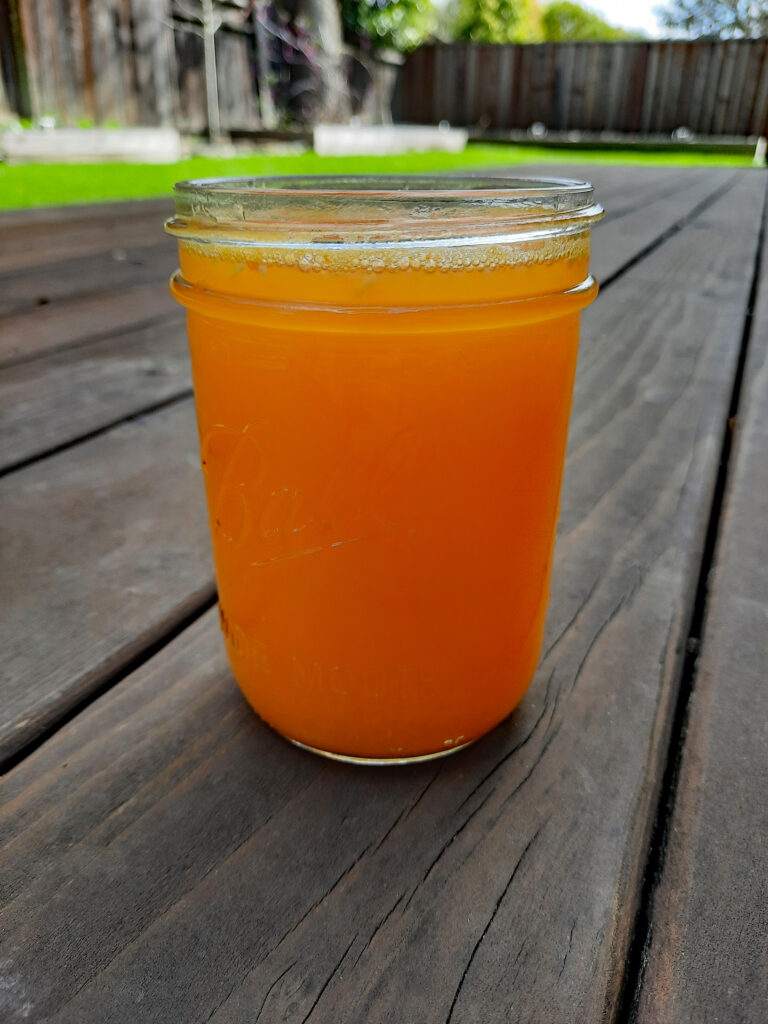
It’s actually juice made from Cara Cara navel oranges, which make the juice darker orange than juice made from regular navels or Valencias, since Cara Caras have pink/darker orange to red flesh in comparison to the lighter orange flesh seen in those more common varieties.

Last week at wholesale produce we purchased a case of Cara Caras and they are amazing! For the most part, I like to peel and eat them, but I couldn’t resist making some juice just to showcase the beautiful deep orange color.

Why are Cara Cara oranges pink/dark orange/red? They contain more carotenoids, including lycopene, than regular navels and Valencias. The average Cara Cara orange doesn’t contain as much lycopene as a tomato, but it’s fun to know that Cara Caras can contribute to one’s dietary economy of lycopene.

The navel and Cara Cara orange samples I saw in Cronometer were not tested for lycopene, but Cronometer did have this interesting information:

Cara Cara orange – one medium
Vitamin C 41 mg
Calcium 57 mg
Alpha-Carotene 155.5 mcg
Beta-Carotene 238.7 mcg
Beta-Cryptoxanthin 626.8 mcg
Lutein and Zeaxanthin 212.5 mcg

Navel orange – one medium
Vitamin C 83 mg
Calcium 60 mg
Alpha-Carotene 9.8 mcg
Beta-Carotene 121.8 mcg
Beta-Cryptoxanthin 162.4 mcg
Lutein and Zeaxanthin 180.6 mcg

Another Cara Cara sample had 90 mg of vitamin C, which shows us that nutrient content can differ between samples. When looking at Cronometer or any other nutrient database, I always check out multiple samples and look for trends in nutrient content of the foods I’m examining. As we can see, Cara Cara oranges are higher across the board in the carotenoids listed in comparison to regular navel oranges, while both are similar in calcium content, which is an impressive yet expected amount for a single orange.

Cara Cara oranges are only around for a short period of time, so enjoy them while you can 😊.

Additionally, would you like to receive our eBook "Our Top 12 Strategies for Long Term Success on A Raw Plant-Based Diet"? Just fill out the email form in the right column of this website and you’ll receive it for free!

12

Two of the many things I love about zucchini (courgette) is that it has a creamy consistency when blended and a relatively neutral flavor, which makes it a wonderful ingredient in savory salad dressings. It also helps to stretch out the fat in nut- or seed-containing salad dressings. When I first got started on my raw food journey, I used water for this purpose until I discovered how zucchini or summer squash can accomplish a similar end, while adding a creamy texture. Sometimes I peel the skin before using it in dressing for a lighter less-green looking dressing.

In addition to zucchini, this dressing contains lemon juice and cashews. Other nuts or seeds that work well with this dressing are walnuts and hemp seeds. I’ve also added a little green onion every now and then for the nice flavor it brings. Of course this is always optional.

Here is the recipe:

3 cups chopped peeled zucchini

1/2 cup cashews or nut/seed of your choice

1 tablespoon fresh squeezed lemon juice

1 tablespoon onion (optional)

1 teaspoon chickpea miso (optional)

Blend all ingredients until smooth. Serves 1 to 2 people.

Enjoy!

Additionally, would you like to receive our eBook "Our Top 12 Strategies for Long Term Success on A Raw Plant-Based Diet"? Just fill out the email form in the right column of this website and you’ll receive it for free!


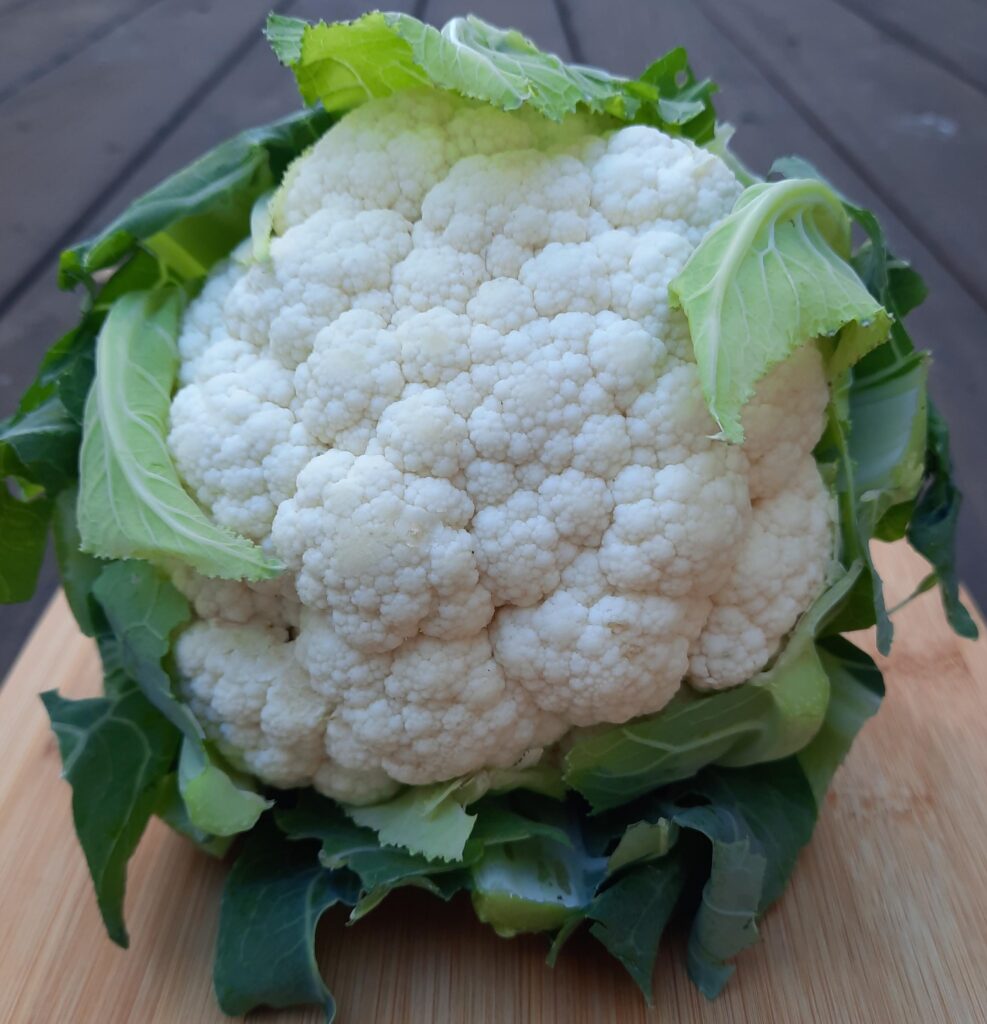
This is a great question, given that many of you know Dr. Rick is a huge fan even though it is seen by many people as being not as flavorful as other fruits and vegetables. The reality is that cauliflower has a good complement of important nutrients, but one nutrient in particular is often overlooked in cauliflower’s nutrition profile.

This nutrient is choline. Why is choline so important? It’s a precursor to phosphatidylcholine, a key component of cell membranes, helping to maintain their structure and integrity. Choline is also used to produce acetylcholine, a neurotransmitter that is vital for brain functions such as memory, mood regulation, muscle control, and overall cognitive function. Choline supports fat metabolism by helping transport fats out of the liver. This prevents the accumulation of fat in the liver and supports overall liver function. It’s also involved in the synthesis of compounds that are essential for the creation of DNA, making it important for cell division and growth. During pregnancy, choline is particularly important for fetal brain development.

Our body can make some choline, but the rest of our body’s requirement for it must be obtained from our diet.

Cauliflower eaten in quantity can be a notable source of choline:
1 cup chopped cauliflower: 47 mg
2 cups chopped cauliflower: 95 mg

One average head has about 5.5 cups chopped cauliflower: 261 mg

There are so many different ways to enjoy cauliflower. Our recipe for stuffing burgers detailed in a recent post is a delicious way to enjoy cauliflower.

Here is the recipe:
3 cups chopped celery
1 ½ cups chopped carrots
2 cups chopped cauliflower
3 tbsp fresh squeezed lemon juice
1 cup walnuts (substitute 2 cups chopped zucchini for lower fat version)
1 cup chopped yellow onion (optional)
1 tbsp rosemary (optional)

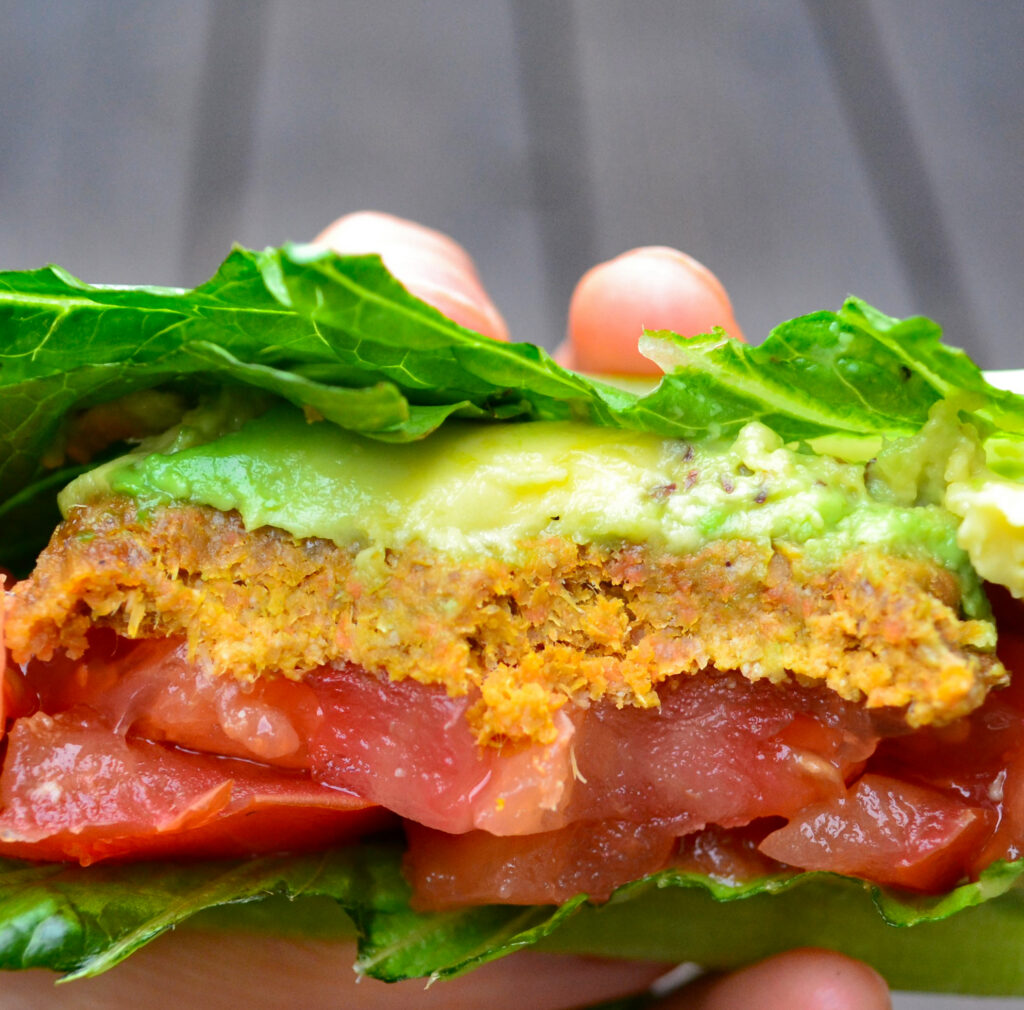
This recipe makes 10 to 12 veggie patties depending on how large you make them. After cleaning the veggies, we blended all the ingredients together in our food processor. We then transferred the mixture to a mixing bowl and to make the patties, we scooped the blended mixture out of the bowl with a ⅓ cup measuring cup and placed the contents of the measuring cup on a dehydrator tray with a dehydrator sheet to keep liquid from the patties from leaking through the dehydrator tray holes.

We dehydrated the patties at 100°F degrees (38°C) for about 7 hours – this time may vary depending on ambient humidity and temperature. We then flipped the patties, removing the dehydrator sheet in the process, and dehydrated the patties for another 3 hours until the patties were ready.

To make a “burger”, we placed one of the patties on a couple of lettuce leaves, then added tomato with a few slices of avocado and a sprinkle of dulse flakes.

This recipe can also be made into raw dehydrated “stuffing” too. Instead of forming individual patties, we spread the mixture onto a dehydrator tray (with a dehydrator sheet) and follow the rest of the dehydrating directions above.

Enjoy!

Additionally, would you like to receive our eBook "Our Top 12 Strategies for Long Term Success on A Raw Plant-Based Diet"? Just fill out the email form in the right column of this website and you’ll receive it for free!

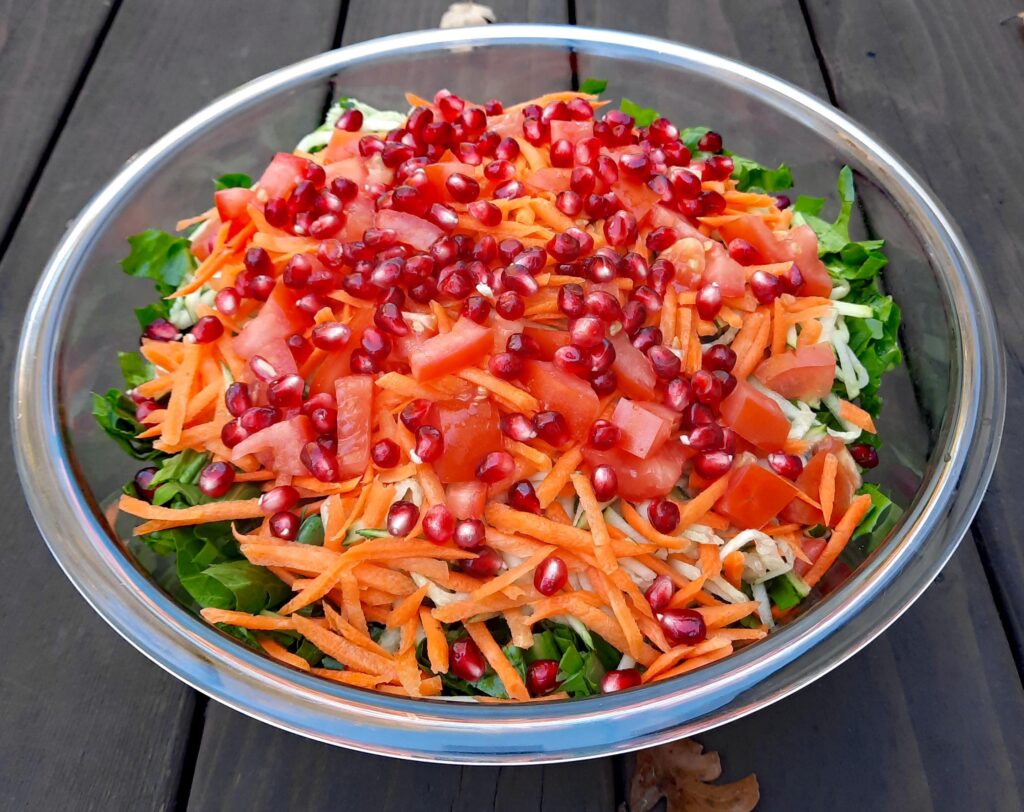
One of our favorite ways to enjoy pomegranates is in the form of juice, but another way we enjoy them is in salad.

Pictured here is one of our standard salads with pomegranate arils:
10 cups torn romaine lettuce (470 g)
3 cups chopped dandelion greens (165 g)
1.5 cups grated cucumber (170 g)
1 cup grated carrots (110 g)
1 cup grated zucchini (149 g)
0.5 cup chopped tomato (90 g)
0.5 cup pomegranate arils (61 g)

Nutrient analysis:
Vitamin B1 0.9 mg
Vitamin B2 1.1 mg
Vitamin B3 5.4 mg
Vitamin B5 2.2 mg
Vitamin B6 1.3 mg
Choline 149 mg
Folate 789 mcg
Vitamin A (RAE) 3864 mcg
Vitamin C 133 mg
Vitamin E 8.1 mg
Calcium 566 mg
Iron 11.5 mg
Magnesium 204 mg
Potassium 3162 mg
Zinc 3.2 mg

The nutrient content of this salad is impressive especially considering that it is 317 calories (kcal)! Nutrient content is one of the many reasons why vegetables and leafy greens are such an important addition to one’s daily diet. Enjoying this salad with the dressing of your choice can increase the nutrient content even more.

I love dandelion greens! I know that may come as a surprise given their often bitter flavor. In the spring, when dandelion greens are young, they tend to be less bitter and as the season progresses, so does their bitterness. But I love the bitterness, along with their crunchy texture. What I love likely the most about them is their nutritional value.

Dandelion greens are in the sunflower plant family (Asteraceae), along with lettuce, endive, escarole, frisée greens, sunflower seeds, and Jerusalem artichokes. The name for this plant has an interesting origin. I remember from a college botany class that the name “dandelion” was derived from the French “dent de lion” meaning “tooth of the lion” or “lion’s tooth”, due to the somewhat jagged tooth-like appearance of dandelion greens. The mineral content of dandelion greens is especially notable:

3 cups chopped dandelion greens (165 g)

Calcium 309 mg
Iron 5.1 mg
Zinc 0.70 mg
Potassium 655 mg
Magnesium 59 mg

As one can see, the leaves of this plant that is often regarded as a garden weed has significant nutritional value!

In addition, dandelion greens are known for their prebiotic fiber content specifically inulin. Three cups of dandelion greens contain almost 20 g of inulin!

Even though we do not have a daily value for prebiotic fiber, we do have established DRIs (specifically Adequate Intakes – AIs) for total fiber:

• 25 g for women (21 g over 50 years of age)
• 38 g for men (30 g over 50 years of age)

To put these numbers in perspective, most Americans get around 15 g of total fiber per day. Standard western diets tend to be lower in fruits, vegetables, and whole plant foods in general so this number is not surprising.

Given what we see here, I love dandelion greens even more!

Additionally, would you like to receive our eBook "Our Top 12 Strategies for Long Term Success on A Raw Plant-Based Diet"? Just fill out the form in the right column of this website and you’ll receive it for free!

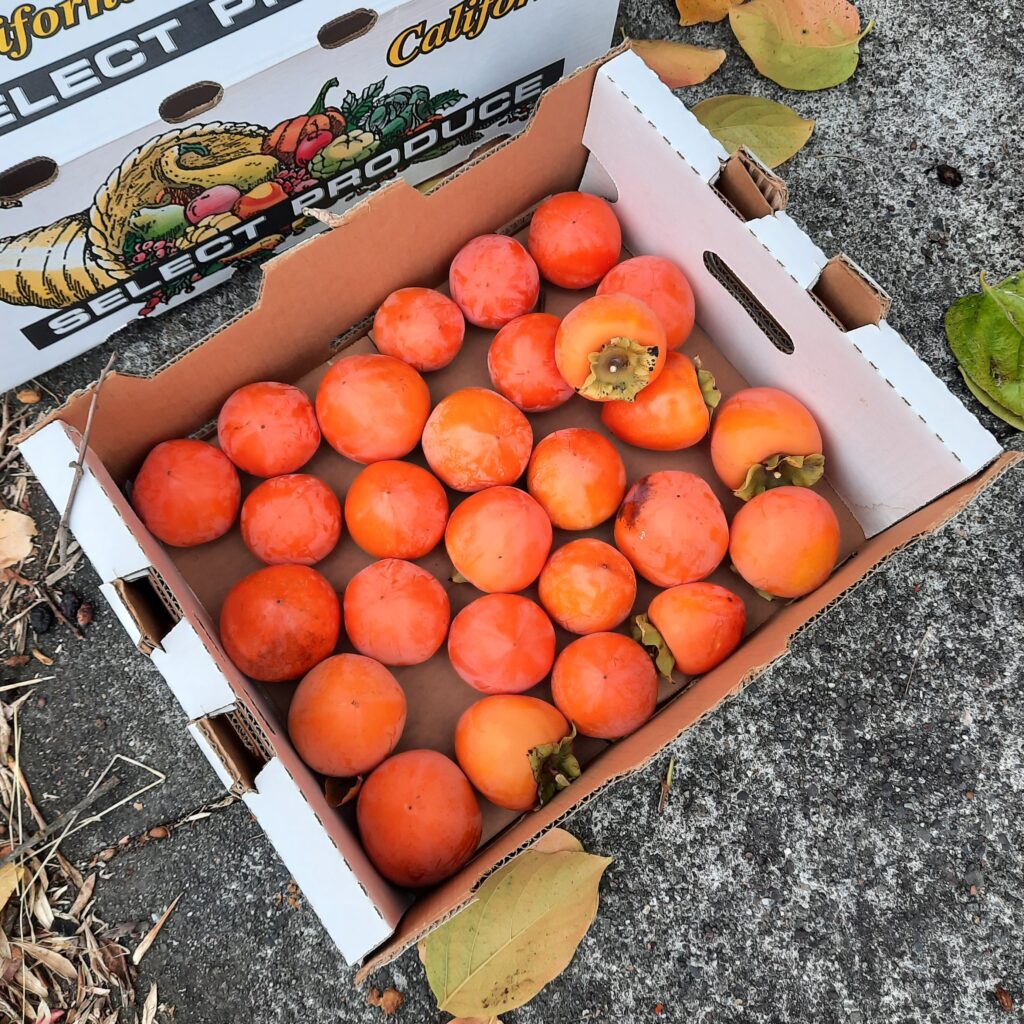
One of my favorite things about the month of November is a beautiful, sweet, orange-colored fruit called the persimmon. Truth be told, I was not aware of the existence of the persimmon until I moved to the west coast in the late 90s. I quickly learned that there are several different types of persimmons, one of which needs to be soft and almost to the point of liquefying to be consumed without having a mouth-puckering astringent taste, which I learned this the hard way, namely the Hachiya persimmon. For me, patience is definitely crucial for successful consumption of this type of persimmon, which involves patiently waiting for full ripeness.

Two other types of persimmons that I have enjoyed are Fuyu and Amagaki, both of which I eat while they are still hard, with very little to no astringency, depending on the degree of ripeness. These three types of persimmons grow here in northern California and are relatively easy to find in local stores and farmers markets during the months of November and December.

Of course, since I love to know the nutrient content of foods, I did a nutrient analysis of persimmons. The type of persimmon used to determine this information was not specified:

Persimmon, 3 fruits (75 g)
Calories 95
Calcium 20.3 mg
Iron 1.87 mg
Potassium 232.5 mg
Vitamin C 49.5 mg
Protein 0.6 g

I was surprised to see the notable iron, vitamin C, and potassium content of persimmons. For a fruit, I find this to be worthy of consideration.

Additionally, would you like to receive our eBook "Our Top 12 Strategies for Long Term Success on A Raw Plant-Based Diet"? Just fill out the email form in the right column of this website and you’ll receive it for free!

Oxalate/Oxalic Acid is a currently popular topic of conversation, but a lot of what is being shared is from one perspective. We like to look at topics from as many perspectives as possible so we can make decisions based on as much information is currently available. This video discusses an important consideration about oxalate/oxalic acid that is not well-known but could potentially be game-changing for some:

And here is a webinar recording that expounds on this topic:

If you would like to see more information like this, please feel free to join our email list in the column on the right and subscribe to our YouTube, Instagram, and FB accounts.

Thanks for watching!

This video discusses newer information about lycopene absorption from different types of tomatoes, that may completely change the conversation on whether or not one needs to cook all tomatoes to absorb lycopene:

If you would like to see more information like this, please feel free to join our email list in the column on the right and subscribe to our YouTube, Instagram, and FB accounts.

Thanks for watching!

In our previous post, we looked at the ingredients of a large salad and the some of the nutrients found in them. In this post, we’re going to add some dressing. When I was growing up, my idea of salad dressing was a relatively thin liquid, but when I started on my health journey, I found that increasing the thickness and amount of dressing used would simultaneously increase my satiety and the nutrient content of the salad, often significantly. This was one of the many game-changer realizations that made a difference for me early on. Over the years, we have developed a number of thicker dressings, including the hummus-style dressing listed below. We particularly love this red pepper hummus for the flavor and the nutrients that it adds to the salad.

Here are the ingredients of the salad from the previous post and the red pepper hummus in this photo:

Salad:

7 cups chopped or torn Romaine lettuce (329 g, 11.6 oz.)

6 cups chopped or torn red leaf lettuce (170 g, 6 oz.)

3 cups chopped or torn dandelion greens (165 g, 5.8 oz.)

1.5 cups shredded cucumber (227 g, 8 oz.)

1 cup shredded carrots (113 g, 4 oz.)

¼ cup chopped tomato (45 g, 1.6 oz.)

Red Pepper Hummus:

3 cups chopped zucchini (445 g, 15.7 oz.)

½ cup walnuts (50 g, 1.8 oz.)

1 tsp. chia seeds (10 g, 0.35 oz.)

Juice of one large lemon (48 ml, 1.57 fluid oz.)

½ cup dehydrated red pepper (30 g, 1.1 oz.)

1 small clove garlic (totally optional) (2 g, 0.07 oz.) not included in nutrient analysis

1 tsp. chickpea miso (totally optional) (7 g, 0.25 oz.) not included in nutrient analysis

AND here are some of the nutrients in this salad and hummus:

 SaladAdult DRIs
Calories (kcal)780 
B11.41.1 – 1.2 mg
B21.71.1 – 1.3 mg
B310.714 – 16 mg
B54.05 mg
B63.11.3 – 1.7 mg
Folate905400 mcg
B1202.4 mcg
C57675 – 90 mg
D05 – 15 mcg
E13.115 mg
K1202190 – 120 mcg
Beta-carotene (mcg)49,578 
Calcium7591,000 – 1,200 mg
Iron17.58 – 18 mg
Magnesium410.7310 – 420 mg
Potassium46914,700 mg
Zinc6.88 – 11 mg 

The salad and red pepper hummus together have exceeded the adult daily values for vitamins B1, B2, B6, C, folate, and K1, all for 780 kcals (calories)! Vitamins B3, B5, and E are close to the adult daily values as are the minerals calcium, iron, magnesium, potassium, and zinc. I encourage you to compare these numbers to the salad without dressing in the previous post and you’ll see how much of a difference dressing can make in the nutrient content of a salad. Additionally, if you desire a lower fat dressing, please feel free to substitute more zucchini or cauliflower for the nuts.

Enjoy!

PS: If this seems like a lot of food, you can always cut the ingredients in half or to your liking and adjust the nutrient content accordingly.

Social Widgets powered by AB-WebLog.com.